Class
Cook the dishes
Farm class near Ubud
- Start price$30
- Dishes6
- MenuRegular or vegetarian
- Rated4.9 from 2,005
Items to tick
Bite-sized answer
Balinese food is island cooking built on a spice paste, with babi guling, ayam betutu, lawar and sate lilit among the dishes Indonesia Travel names.
Handy to know
Before you cook · 9 items
Mark each item as you finish it; your ticks stay on this device.
0 / 9 ready
Every box ticked. Only the booking is left: your place at the farm stove.
Hold my place at the stoveWhat Balinese food is, which dishes carry it, how heat and spice are handled and where a cooking class near Ubud fits in, using Indonesia Travel and the research agency BRIN.
Editorial team, balinesecookingclass.com · Updated November 3, 2026 · Roughly 6 min of reading
Start with these lines
Traditional Balinese food is the cooking of an island where social and cultural life is closely connected to Hinduism, as Indonesia Travel puts it.5 That connection is visible at the table, where the best-known dish is a roast pig and the dishes that follow it lean on a shared set of spices.1
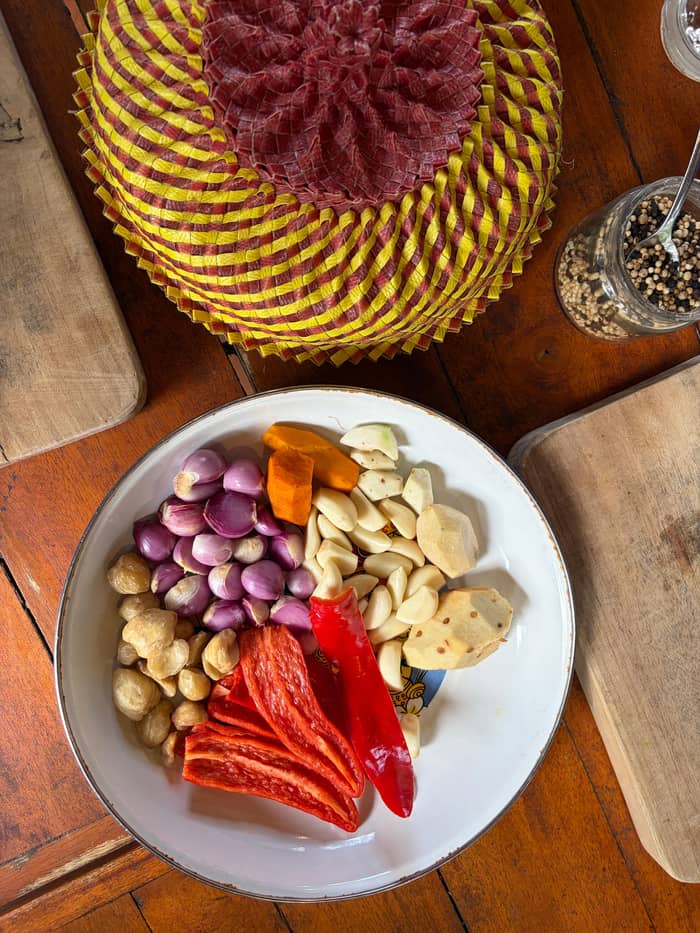
Indonesia Travel says each Balinese dish is crafted with an abundance of local herbs and spices.6 Its articles name the mix as bumbu genep, and its Bali dish list refers to a base genep paste, the same idea under slightly different spellings.7,2
This page is a map rather than a menu: first the dishes people look for, then the spice behind them, then how heat is handled and where a class slots in. For the paste itself, read our page on base genep, and for the heat question, our page on spice, vegetarian and halal choices.
Dishes in one grid
| Dish | Main thing in it | How it is cooked | Heat |
|---|---|---|---|
| Babi guling | Pork, stuffed with spices | Spit-roasted | Sambal can be very hot |
| Ayam betutu | Chicken in base genep | Slow-cooked for hours | Usually quite spicy |
| Sate lilit | Minced fish or chicken | On a stick | Mild |
| Lawar | Vegetables, coconut, meat | Finely chopped | Medium |
| Tum ayam | Minced chicken, spices | Steamed in banana leaf | Mild to medium |
| Tipat cantok | Rice cake, vegetables | Tossed in peanut sauce | Can be ordered without heat |
| Bubur injin | Black glutinous rice | Sweetened with palm sugar | Not spicy |
| Jaje laklak | Rice flour pancakes | Green from suji leaves | Not spicy |
Dish contents and cooking as Indonesia Travel states them; heat is as its article describes it.1,2,10,11,12,18,4,19,20,21,22,23,24,25,26
Perhaps the most famous Bali food, babi guling is a whole pig stuffed with traditional spices and spit-roasted.1 It is marinated with turmeric, garlic, coriander seeds, lemongrass and other spices.9 Ayam betutu, called the king of Balinese poultry dishes, is chicken marinated in a base genep paste and slow-cooked for hours.2
Sate lilit uses minced fish or chicken mixed with grated coconut and lime juice, unlike a typical satay.10 Lawar is a finely chopped mix of vegetables, coconut and minced meat.11 Tum ayam is minced chicken and spices steamed in a banana leaf.12
Rujak bulung is fresh seaweed drizzled with a fish broth called pindang and chili,13 and nasi tepeng is a rice dish in a thick spicy gravy, a specialty of Gianyar.14 Gianyar is the regency where Ubud lies, so a class near Ubud sits close to that dish.
What goes into the paste
Nasi campur Bali is a scoop of rice surrounded by small portions of sate lilit, ayam betutu, lawar and the iconic sambal matah.3 It is the easiest way to taste several dishes at once, and the table at the end of a class lunch often looks like it, with small plates around the rice.
For visitors who eat rather than cook, Indonesia Travel points to Warung Mak Beng in Sanur, a culinary institution since 1941 and famed for its fried fish and fish soup.8 That is a different Bali table, built on one dish done daily rather than on a whole plate of small ones.
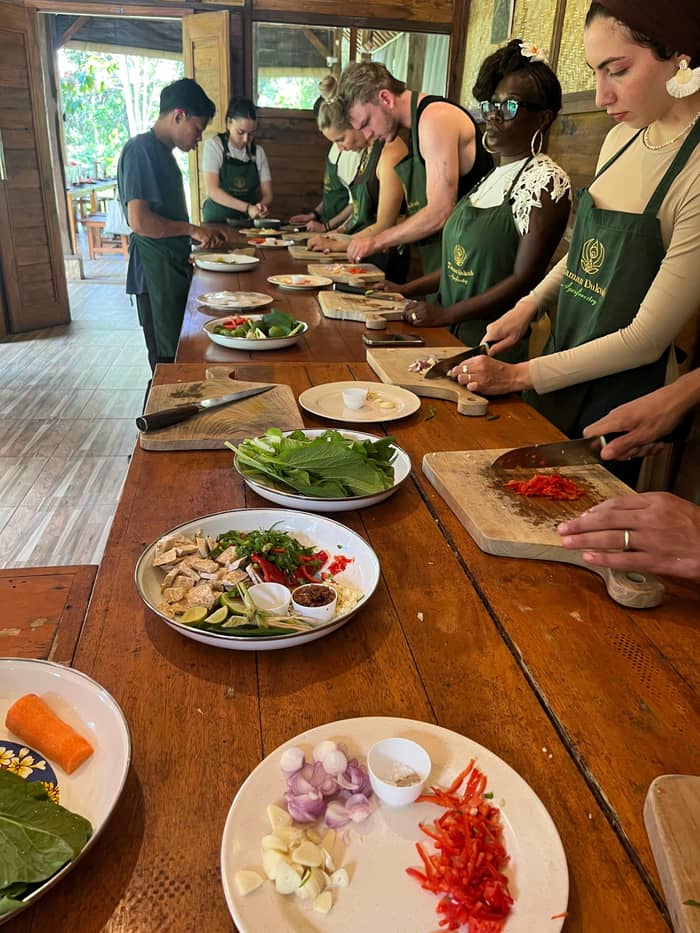
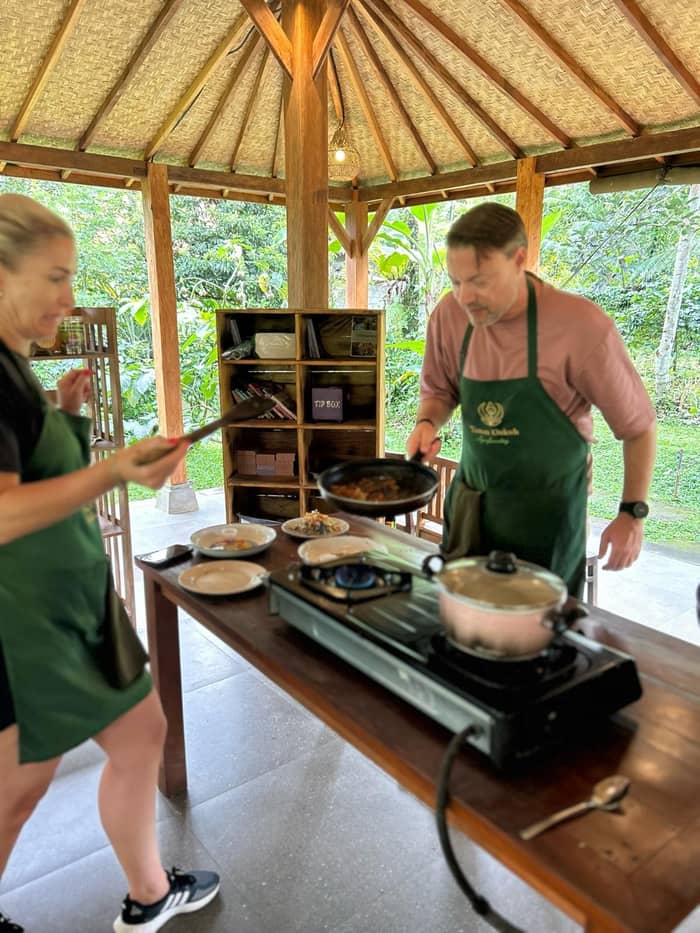
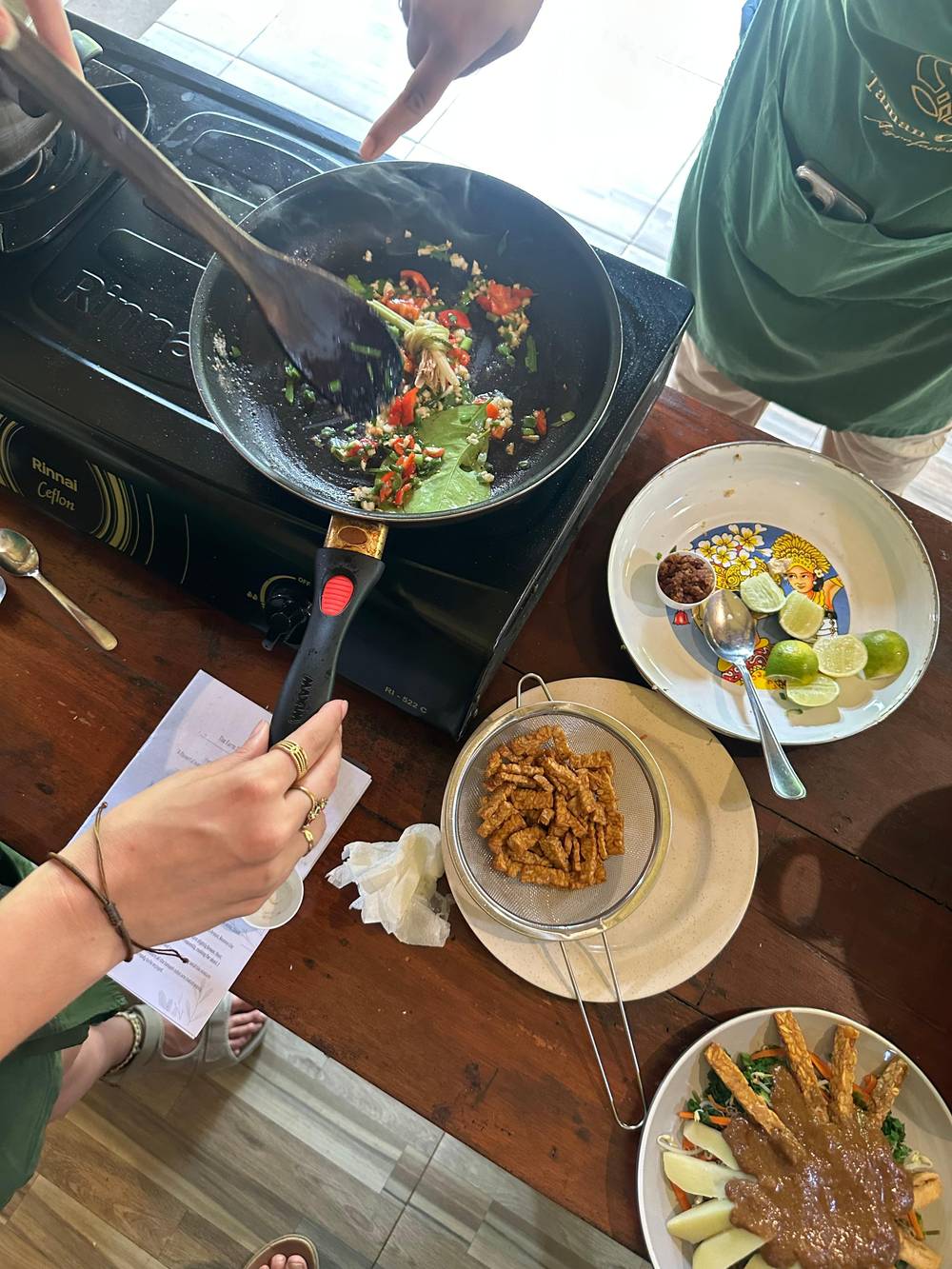
A cooking class gives you the plate from the inside. Our farm class cooks a regular menu with sate lilit, a chicken curry and sweet and sour tempe, or a vegetarian menu with a vegetable and peanut sauce plate and a vegan sate lilit. Either way you cook 6 dishes and eat them, and the recipe book goes home with you.
Match the dish to your taste
Pick the line closest to your appetite and read the answer.
If I want the famous one
Babi guling
A whole pig stuffed with spices and spit-roasted.1
If I do not eat pork
Ayam betutu, and ask about the rest
Chicken in base genep.2 Sate lilit can be made with pork in some kitchens, so ask which meat is used.
If I want little heat
Tipat cantok, ordered tidak pedas
Ask for tidak pedas.18
If I want a sweet ending
Bubur injin
Black rice with palm sugar.4
If I want many tastes at once
Nasi campur Bali
Sate lilit, betutu, lawar and sambal matah around one rice scoop.3
If I want to cook it
A class near Ubud
Our farm class cooks 6 dishes.
Three ways to meet the food
Class
Farm class near Ubud
Class
Dessert class, Ubud
Class
Seminyak
Indonesia Travel describes lawar as seasoned with fresh spices like garlic, chilies and turmeric,17 and sate lilit as mixed with grated coconut, lime leaves, lemongrass and traditional Balinese spices.16 Chicken betutu is cooked with a rich blend known as betutu seasoning.28
Heat is a matter of the sambal and the dish. Tipat cantok, sliced rice cake and steamed vegetables in peanut sauce, can be ordered without heat: Indonesia Travel says to ask for tidak pedas if you cannot handle it.18,29
A cook can also leave the heat out at the stove. One Ubud class says non-spicy options can be arranged, and the farm class lets you pick the menu in advance.
Make it at the stove
Enter how many are cooking and compare four classes.
Line up 4 classes
Enter how many are cooking and compare four classes.
≈
View≈
View≈
View≈
ViewLowest GetYourGuide prices, converted at the ECB rate; the final total appears at checkout.
A Balinese day of eating
Morning
Our class begins at a market, and a light breakfast follows at the farm.
Midday
Six dishes are cooked, with the paste first on both menus.
Lunch
Nasi campur shows how many dishes sit around one rice mound.3
Afternoon
Bubur injin or banana fritters close the menu.
Evening
Fried fish and fish soup in a warung in Sanur is one option.8
BRIN, Indonesia's national research agency, notes that Balinese people associate cuisine with religious rituals, with food serving as offerings to the deities, including base genep.27 Food is therefore more than fuel on the island, and a class that explains the paste is explaining part of the culture. Listen for the names of the spices as the chef pounds them, and for the order in which they go into the stone mortar; those details are what separate a recipe from a lesson, and they are the part you cannot copy from a printed card. If you take notes, take them in your own words: the farm class sends you home with a recipe book.
RRI, the public broadcaster, puts 15 spices in base genep, locally grown, fresh and dried, and says their aromas and flavors combine into a rich mixture.15,30 It adds that the use of 15 wet and dry spices reflects the variety of plants available within Balinese culinary practices.31
You do not need to follow the ritual to cook the food, but a good guide mentions it. Ask your chef about the offerings at a family compound; the rice field class and the market-to-table class both list a traditional offering as part of the morning.
Video
Duane & Isa on YouTube · The video waits until you press play.
Balinese people associate cuisine with religious rituals as food serves as offerings to the deities, including Base Genep.
Bubur injin is a dessert of black glutinous rice sweetened with palm sugar,4 and jaje laklak are small green pancakes that get their color from suji leaves.19 On our farm class's menus dessert is either banana fritters or black rice pudding.
A separate Ubud class is dedicated to desserts: five traditional Balinese cakes, a session of 1 to 1.5 hours, from $16.
If sweets are why you came, that class is a cheaper entry than a day class, but it will not teach you the savoury paste. Choose by what you want to eat tonight and what you want to cook next month at home. Sweet dishes also travel better than most, since palm sugar, coconut and rice flour are easy to find in an Asian grocery abroad.
Eating Balinese food and cooking it are different pleasures. In Ubud you can do both on the same morning: the farm class starts at a local market and ends at the table with the dishes you cooked.
If you stay in the south, the Seminyak market class is listed at 4 hours, from $45, with 528 reviews, and Indonesia Travel says Seminyak restaurants are mostly found along Jalan Laksmana.32
Before you travel, write down three dishes from this page that you want to eat, and match them to a menu. A class that cooks sate lilit, betutu or lawar names the dishes on its booking page, and our farm class does, so you can check the match before you book. Treat the list in this guide as a starting point rather than a rulebook: every family and every warung adjusts the proportions, and a dish you meet in Bali may taste different from the one in the book. Ask the cook what goes in, and ask for the heat to be turned down or up, which is a normal request.
FAQ
Indonesia Travel says an abundance of local herbs and spices goes into each dish.6
Indonesia Travel calls it perhaps the most famous Bali food, a whole pig stuffed with spices and spit-roasted.1
Sate lilit, ayam betutu, lawar and sambal matah sit around the rice.3
Tipat cantok is rice cake and steamed vegetables in peanut sauce,18 and our farm class has a vegetarian menu.
RRI describes it as a blend of 15 locally grown fresh and dried spices.15
Our farm class cooks 6 Balinese dishes, and the village and Seminyak classes also teach Balinese dishes.
It is black glutinous rice sweetened with palm sugar.4
Sources
Keep reading
Questions about the market, the menu or the farm? A person answers here.