We send you here
Paste first
Farm class near Ubud
- Start price$30
- Length of classRuns 5.5 to 8 hours
- GroupMax 14 cooks
- Rated4.9 from 2,005
Sum for your cooks
Bite-sized answer
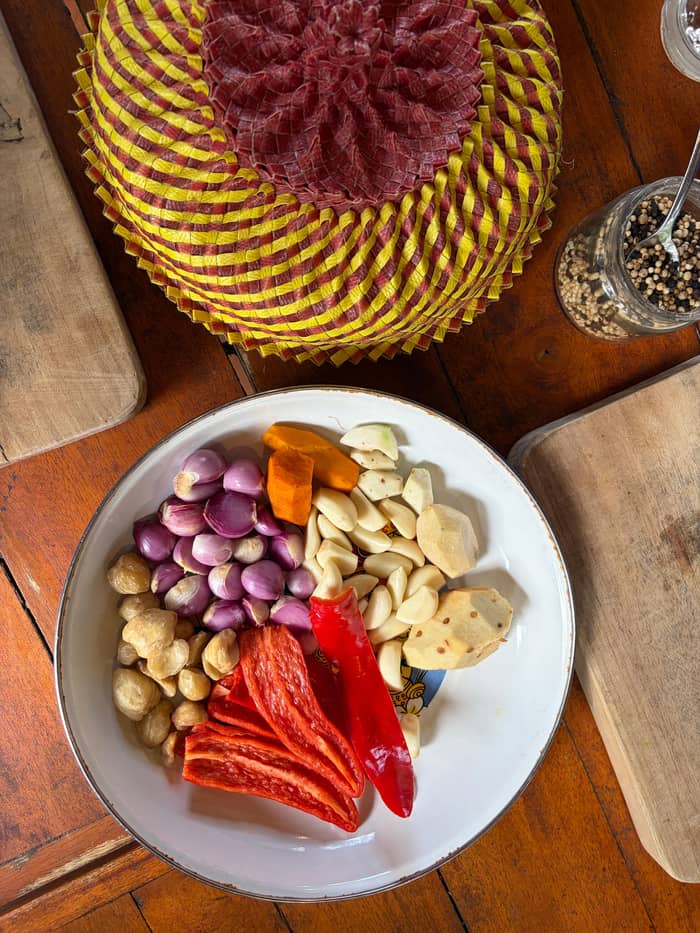
Base genep is a traditional Balinese spice blend made from 15 locally grown fresh and dried spices, and our farm class makes a paste first on both menus.
Around the paste
Line up 4 classes
Change the group size to see the from-prices for each class in total.
≈
View≈
View≈
View≈
ViewLowest GetYourGuide prices, converted at the ECB rate; the final total appears at checkout.
What base genep is, why it is said to hold 15 spices, which dishes lean on it and how a cooking class near Ubud starts its menu with a paste, with the sources named along the way.
Editorial team, balinesecookingclass.com · Updated November 3, 2026 · Roughly 6 min of reading
Start with these lines
Base genep is a traditional Balinese spice blend made from 15 locally grown fresh and dried spices, says RRI, Indonesia’s public broadcaster.1 It combines ingredients with distinct aromas and flavors to create a rich spice mixture.4
Indonesia Travel uses the spelling bumbu genep in its own writing, and calls it a Balinese spice mix.5 In both spellings the word points to completeness, the paste being the full set of flavours that a dish starts from. Treat the number as RRI states it, and read the word genep as completeness rather than as a count.
We name the sources because the paste is often described loosely. The numbers on this page are those of RRI and BRIN; anything else, such as a family recipe, belongs to the family. The paste is better understood as a method than as a fixed recipe. RRI notes that recipes using the blend have been passed down, and a cook in a class will show you their own balance of the ingredients.
The paste in dishes
| Dish | Named in the seasoning | How it is cooked | Heat rating |
|---|---|---|---|
| Ayam betutu | Base genep paste | Slow-cooked for hours | Usually quite spicy |
| Babi guling | Turmeric, garlic, coriander seeds, lemongrass | Spit-roasted | Sambal can be very hot |
| Lawar | Garlic, chilies, turmeric | Finely chopped | Medium |
| Sate lilit | Grated coconut, lime leaves, lemongrass | On a stick | Mild |
Seasoning and cooking as Indonesia Travel states them.2,7,8,9,10,11,12,13
In RRI's reading, 15 wet and dry spices show how many plants Balinese cooks have to draw on.6 Fresh and dried ingredients sit side by side in one paste.
Our farm class does not list the individual spices, but it names a traditional spice paste, base gede, as the first dish of both its regular and its vegetarian menu.
That is the practical lesson: the paste is not an extra step but the foundation of the menu. A class that makes it first gives you a base you can reuse for the dishes after it. Ask the chef why the order of the steps matters and which ingredients are fresh and which dried. A question in the kitchen teaches more than a printed card, and the answers are the part worth writing down.
Where to learn it
Bars show the lowest start price GetYourGuide lists today for each class, not a quote for your date.
Ayam betutu, chicken in a complex base genep marinade, is slow-cooked for hours until the meat falls off the bone.2 Indonesia Travel also mentions a rich blend called betutu seasoning for the dish.15
Seasoning lists differ by dish. For babi guling Indonesia Travel names turmeric, garlic, coriander seeds and lemongrass.7 Lawar gets garlic, chilies and turmeric,8 while sate lilit takes grated coconut, lime leaves and lemongrass.9
Indonesia Travel adds that herbs and spices, local ones and plenty of them, go into each Balinese dish.16 That is how one blend can taste different in each pot. The paste is also what lets one cook handle many dishes in a morning. Make it once, divide it, and the chicken, the vegetables and the tempe can each take their share, which is a practical reason to learn it first.
Match the paste to you
Find the line that matches your plans and see what we would book.
If I want to cook it
The farm morning
A spice paste is the first dish on both menus.
If I want to taste it
Order ayam betutu
Chicken marinated in base genep and slow-cooked.2
If I want to understand it
Read the BRIN note
Food as an offering, base genep included.3
If I want it vegetarian
The vegetarian menu
It keeps the paste.
If I want less heat
Say tidak pedas
Ask when ordering.14
If I want a short lesson
The transfer class
Listed at 2 to 3 hours.
Three ways to learn it
We send you here
Farm class near Ubud
Mid length
Laplapan
Short
Ubud, with transfers
BRIN, the national research agency, observes that in Balinese ritual food is offered to the deities, and base genep is among those offerings.3 Reading about the paste before you go makes the morning richer, since the names the chef uses will already be familiar and your questions can go further.
RRI mentions a duck dish, bebek timbungan, that follows traditional preparation guidelines associated with the historical Dharma Caruban manuscript.1
A visitor does not need to know the manuscripts to cook the paste. What you gain from knowing that the paste has this role is a better sense of why a Balinese cook measures it with care. The ritual side turns up in class programmes too: the rice field class has you make a traditional offering, and so does the market-to-table class.
From market to paste
First
The class opens at a local market.
Then
Coffee or tea on arrival, with a light breakfast.
Next
You pick vegetables for the dishes.
At the stove
The first dish on both menus is the spice paste.
For the last course
You eat the meal and take the recipe book home.
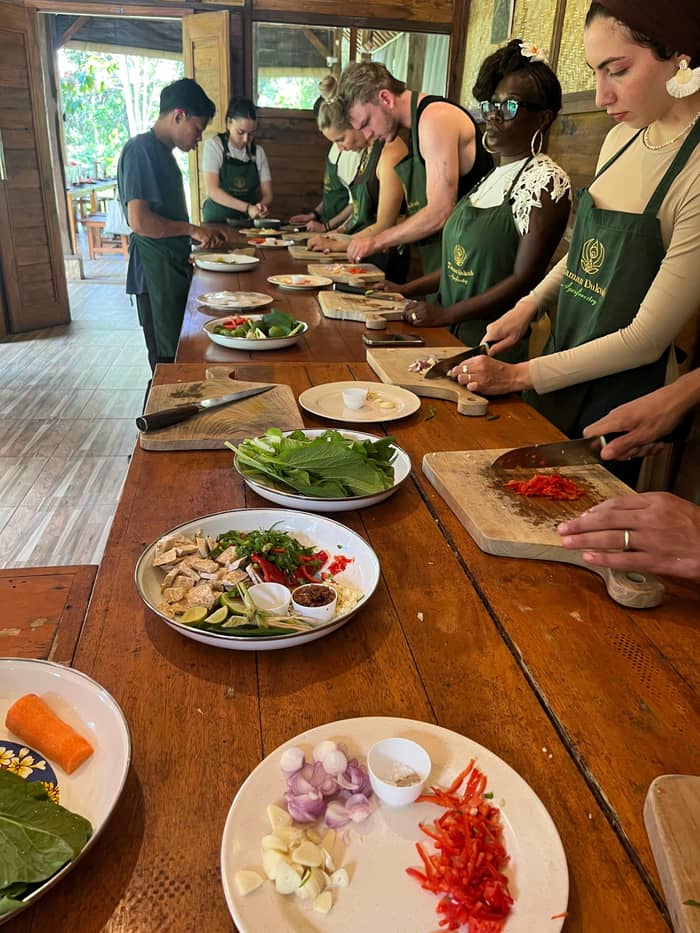
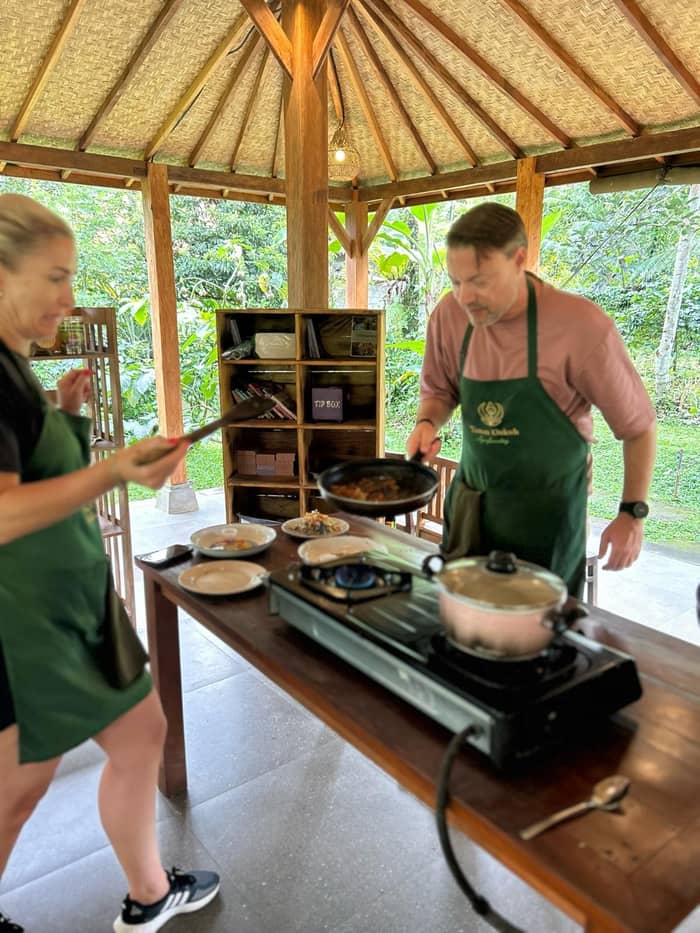
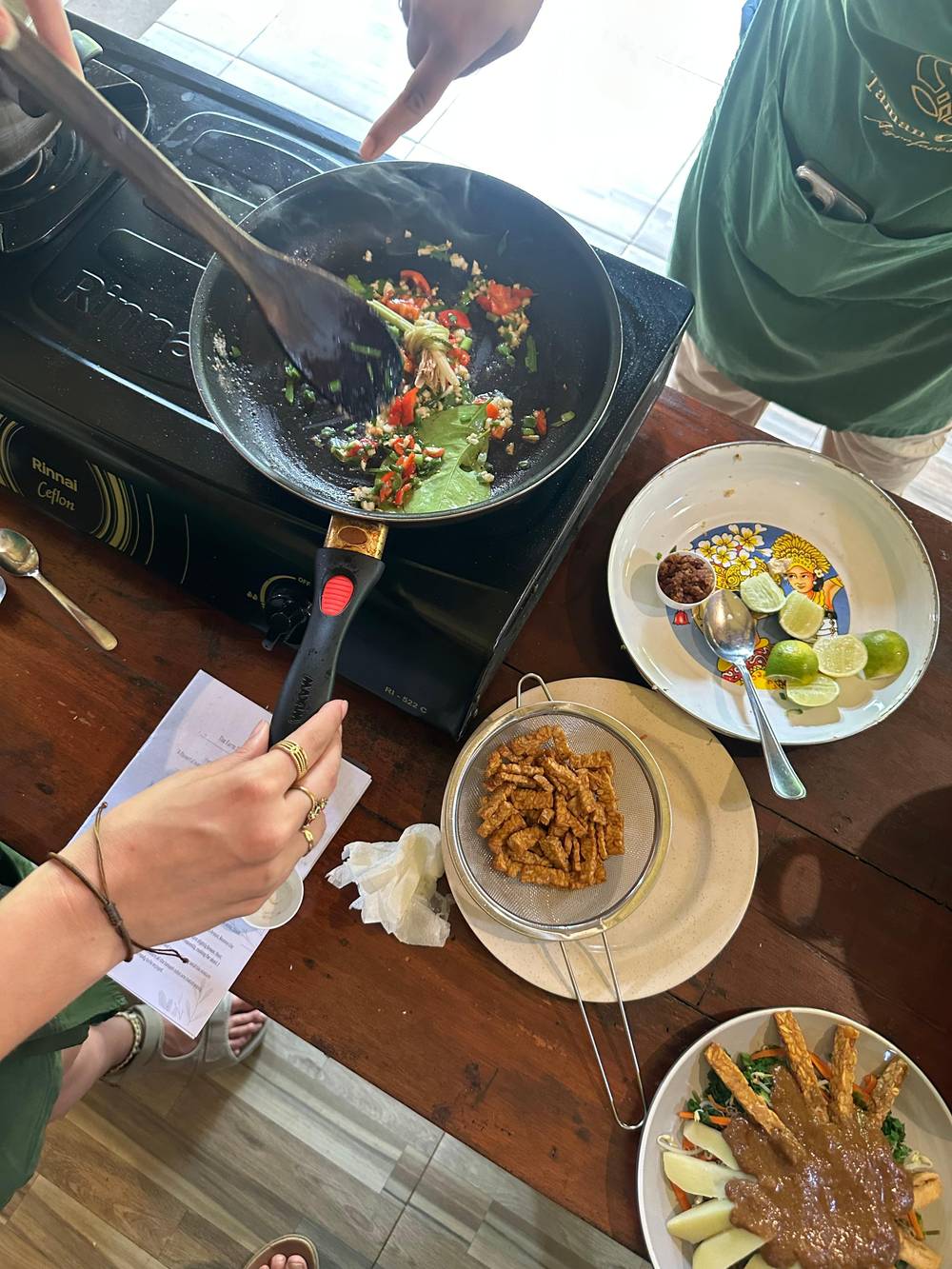
On our farm class you start with a market tour, then coffee or tea with a light breakfast, a farm walk to pick vegetables, and finally the cooking. The first dish on both menus is the spice paste. The chef guides the class, and two people share each cooking station. Come hungry, because every dish you make is on the table at the end.
You cook 6 dishes in a small group of at most 14, sharing a station with a partner, and you keep the recipe book.
If your goal is to take the paste home, the recipe book matters more than the photographs. Ask the chef to explain which ingredients are fresh and which are dried, and write down the order in which they are pounded. Lay your own questions out before the day: which spices are pounded fine and which are sliced, how much goes into the pot and how long the paste keeps. A chef is glad to answer a question that comes before the knife is picked up. If the chef allows it, photograph the paste at each stage; the change in colour and texture is the quickest reminder of the order when you cook it again at home, long after the notes have gone missing.
Video
The Culinary Institute of America on YouTube · The video waits until you press play.
Base Genep is a traditional Balinese spice blend made from 15 locally grown fresh and dried spices.
Before you pound a paste
The paste is not the same as heat. Indonesia Travel lists chilies among the spices for lawar,8 and tipat cantok can be ordered without heat by asking for tidak pedas.14 If you want to cut the burn without losing the character, ask the cook to reduce the chilies and keep the roots and herbs, so that the aroma stays while the heat drops.
Vegetarians are not left out. The farm class lists base gede on its vegetarian menu, next to a tempe curry and a jackfruit version of sate lilit that is vegan. Our records state that the paste is the first dish of the vegetarian menu too, and the list that follows it has no meat dish at all, so you can book it as a vegetarian without feeling you have chosen the lesser class.
If you need the paste without animal products, ask the cook what goes in. A paste of fresh and dried spices has no obvious reason to contain meat, but a cook’s recipe is the only authority, and a message before you book settles it.
The farm class starts from $30, lists 5.5 to 8 hours and carries 2,005 reviews at 4.9. The village class starts from $35 and the transfer class from $20.
Cancel the farm class at least 24 hours ahead for a full refund; reserving first with payment later is allowed.
Visitors from abroad also settle Bali's Rp 150,000 levy, one time a person for the whole stay, with no cash: the Love Bali system online before landing, or the counters at airport and port.17,18 Whether you choose the farm, the village or the quick class, check the booking page for the date you want, the menu choice and the pickup line. A paste is only as good as the morning you spend making it, and a calm morning with time to ask questions is worth more than a rushed one.
FAQ
RRI gives it 15 locally grown spices, fresh and dried.1
Fresh and dried spices both count.6
The chicken is marinated in it and slow-cooked for hours.2
Our farm class makes a spice paste first on both menus.
Ask the cook what goes in.
The farm class lists a full refund.
Sources
Keep reading
Questions about the market, the menu or the farm? A person answers here.