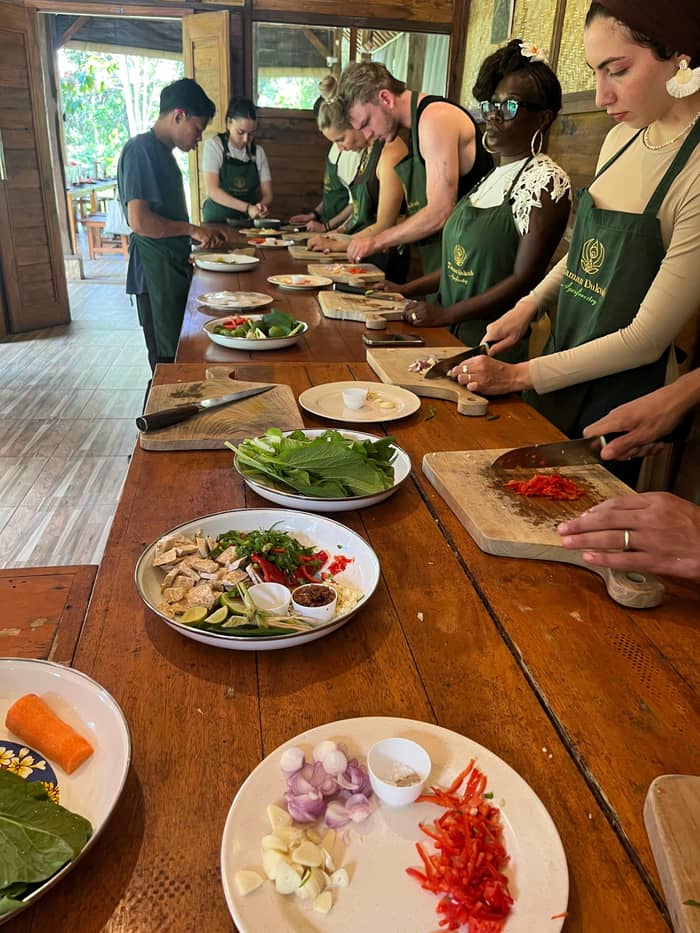
We send you here
Market, then farm
Close to Ubud
- Start price$30
- Length of classRuns 5.5 to 8 hours
- MarketTour first
- Rated4.9 from 2,005
Sum for your cooks
Farm cooking class with a market tour and six dishes
★ 5.0 · 2,005 guest reviews
Bite-sized answer
A Balinese cooking class with a market tour, like our farm class, opens at a local market, while the afternoon sessions of the village and rice field classes skip it.
Market notes
Line up 4 classes
Set the number of cooks and compare what each class starts from.
≈
View≈
View≈
View≈
ViewLowest GetYourGuide prices, converted at the ECB rate; the final total appears at checkout.
Most classes near Ubud open at a market, but not every session does. This guide shows which listings include the visit, which skip it in the afternoon and how the morning runs from stall to stove.
Editorial team, balinesecookingclass.com · Updated November 3, 2026 · Roughly 6 min of reading
Start with these lines
A market tour is the part of a class that explains the ingredients before you hold them. Indonesia Travel describes one well-known Ubud class as beginning at a local market where you learn about the herbs, spices, fruits and vegetables.2 The point of the visit is orientation. You meet the vegetables, roots and herbs in their raw state, which makes the recipe on the farm table easier to follow.
Our farm class opens the same way: the first stop is a tour of a local market, and only then do you arrive at the farm, with coffee or tea and a light breakfast to start. The Seminyak class adds that the chef tells you what goes into each dish and where to source those ingredients once you are home.
Indonesia Travel calls the Ubud market a bustling hub of several small stalls selling everything from fresh produce to local wooden and shell craft.3 It also lists the Ubud market as a place that sells handicrafts made in Bali as souvenirs,4 so a class market may be a different place from the tourist one. Read the market as part of the lesson and not as a detour: it is where the class gets its first lesson in what the dishes are made from.
Market stops in one grid
| Class | Stall visit | Afternoon | Length of class |
|---|---|---|---|
| Farm class | Tour first | Silent on this | Runs 5.5 to 8 hours |
| Village class | Market visit | Shorter, no market | Runs 3.5 to 4 hours |
| Rice field class | Walk through the stalls | Market closed | Runs 3.5 to 5 hours |
| Transfer class | Optional | Silent on this | Runs 2 to 3 hours |
| All-inclusive class | Pasar Pejeng, 30 minutes | Silent on this | Runs 5 hours |
| Sanur class | Optional tour | Silent on this | Runs 2.5 hours |
As each listing states it; "not stated" means our record has no line.
The farm class near Ubud lists a market tour before the class. The village class in Laplapan lists a market visit too, and says its afternoon class is shorter because it does not include the market tour. Keep in mind that a listing is a summary written by the operator and the platform, so a line that is silent about the market does not prove that the class skips it; where our record says nothing, we say nothing, and the table marks it as not stated.
The rice field class and market tour near Ubud says there is no market visit in its afternoon class because the market has already closed. The private family-home class adds that market availability may vary with the time of day.
The transfer class lists the market visit as optional, and the Sanur class lists an optional market tour. Treat a morning start as the safe way to see a market, and read the start time on the booking page for your date. If a market stop is a must for you, say so in a message before you book, because the listing text is a summary and the operator holds the exact programme for your date.
How long a market class takes
Longest length each listing gives by option; shorter options exist.
The all-inclusive Ubud class is the one that names its market. Its stops list five pickup options, a car ride of 30 minutes, a visit of 30 minutes at Pasar Pejeng local market, and the drive on.
That is a short visit by design: 30 minutes is enough to walk the aisles with a guide and taste local fruits, which the listing says you do.
The class is listed at 5 hours and starts from $23, with pickup included and a rating of 4.7 from 142 reviews. Because the listing gives the market a fixed half hour, it works for visitors who like a short, guided look rather than a long browse; a slower pace would need a different class.
Match the market to you
Which line sounds like your day? The answer sits next to it.
If I want the market first
The farm morning
It opens with a market tour.
If I can only do an afternoon
A class that says so
The village and rice field classes skip the market then.
If I want a named market
The all-inclusive class
Pasar Pejeng for 30 minutes.
If I might skip the market
The transfer class
The market visit is optional.
If I want pickup
The village or all-inclusive class
Both list pickup.
If I am travelling on Nyepi
Choose a different date
All markets are closed.1
Three market mornings
We send you here
Close to Ubud
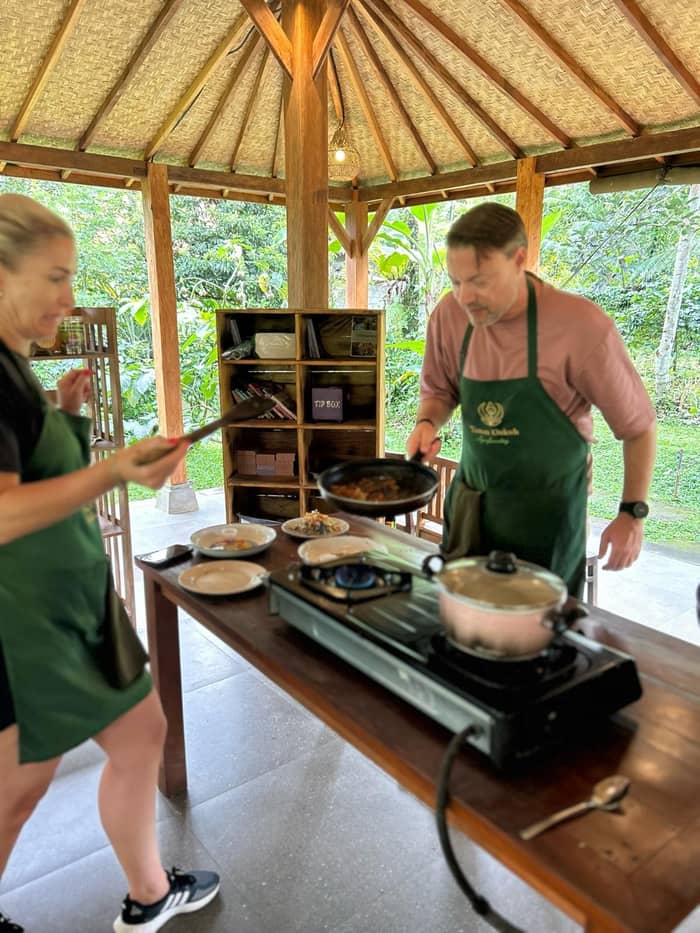
Village
Laplapan
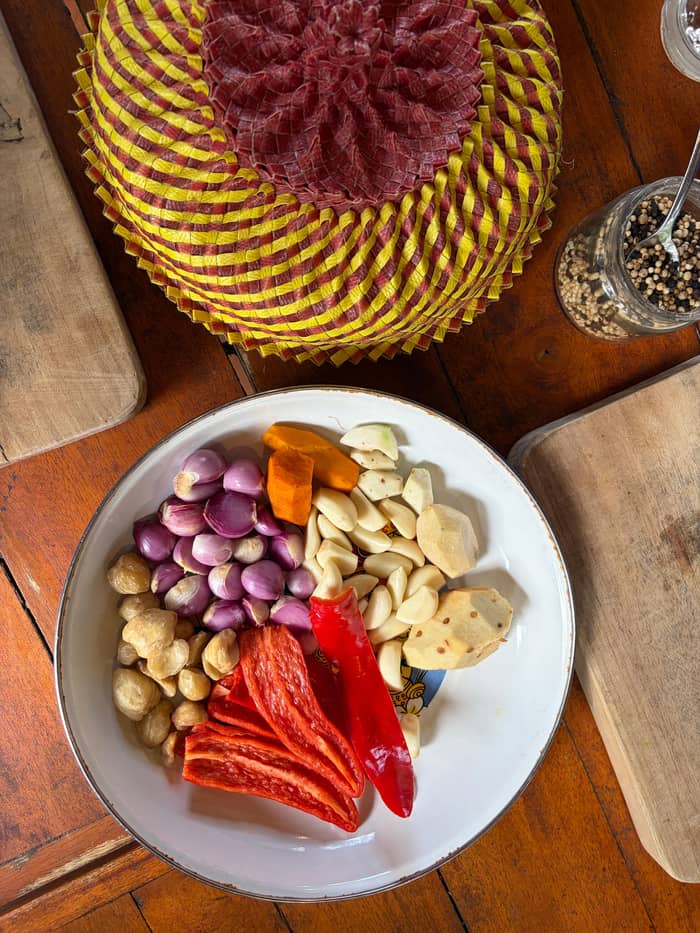
All-inclusive
Pasar Pejeng
A Balinese morning market is where cooks buy the day's produce. The classes pitch the visit as a way to see the ingredients: the Seminyak class has the chef explain what each dish needs, and an Ubud class lists a tour of the morning market and tasting local fruits. Expect the ordinary business of a market: vendors weighing produce, shoppers choosing quickly and a guide who stops at the stalls that matter for the menu. Slow down for a taste when one is offered.
One class in a family home adds a coconut oil demonstration and a small daily offering to the market visit, listed at 4.5 hours with pickup included.
You do not need to bring much. A little cash for fruit and snacks is handy, and light clothes suit the morning heat. Keep your bag small, since the market aisles are narrow. If you are curious about the offerings you see in front of shops and at doorways, the family-home class makes a small daily offering as part of its programme, which gives you the context for what you saw.
A market morning, in order
Pickup
A car collects you at one of five pickup options on the all-inclusive class.
Half an hour
The stops list a car ride of 30 minutes.
Half an hour
A visit of 30 minutes at Pasar Pejeng, tasting local fruits.
Then
The class returns to Ubud to cook.
When the plates arrive
You sit down to the meal together.
Morning markets run early, and the listings reflect it: the village and rice field classes lose the market stop in the afternoon. That school's morning classes are listed from 08.30 AM, and its afternoon ones from 03.30 PM.5
On Nyepi, the Balinese day of silence that lands in March or April and shifts each year, all shops and markets are closed, and everyone in Bali, visitors included, must stay in for 24 hours.6,7,1
Plan around the date: a class booked near Nyepi will not have a market stop, and the island's airport and transport hubs shut that day as well.8 The simplest way to avoid a closed market is to look at a calendar before you book: Nyepi moves from year to year, so the date you saw last time will not be this year's.
Video
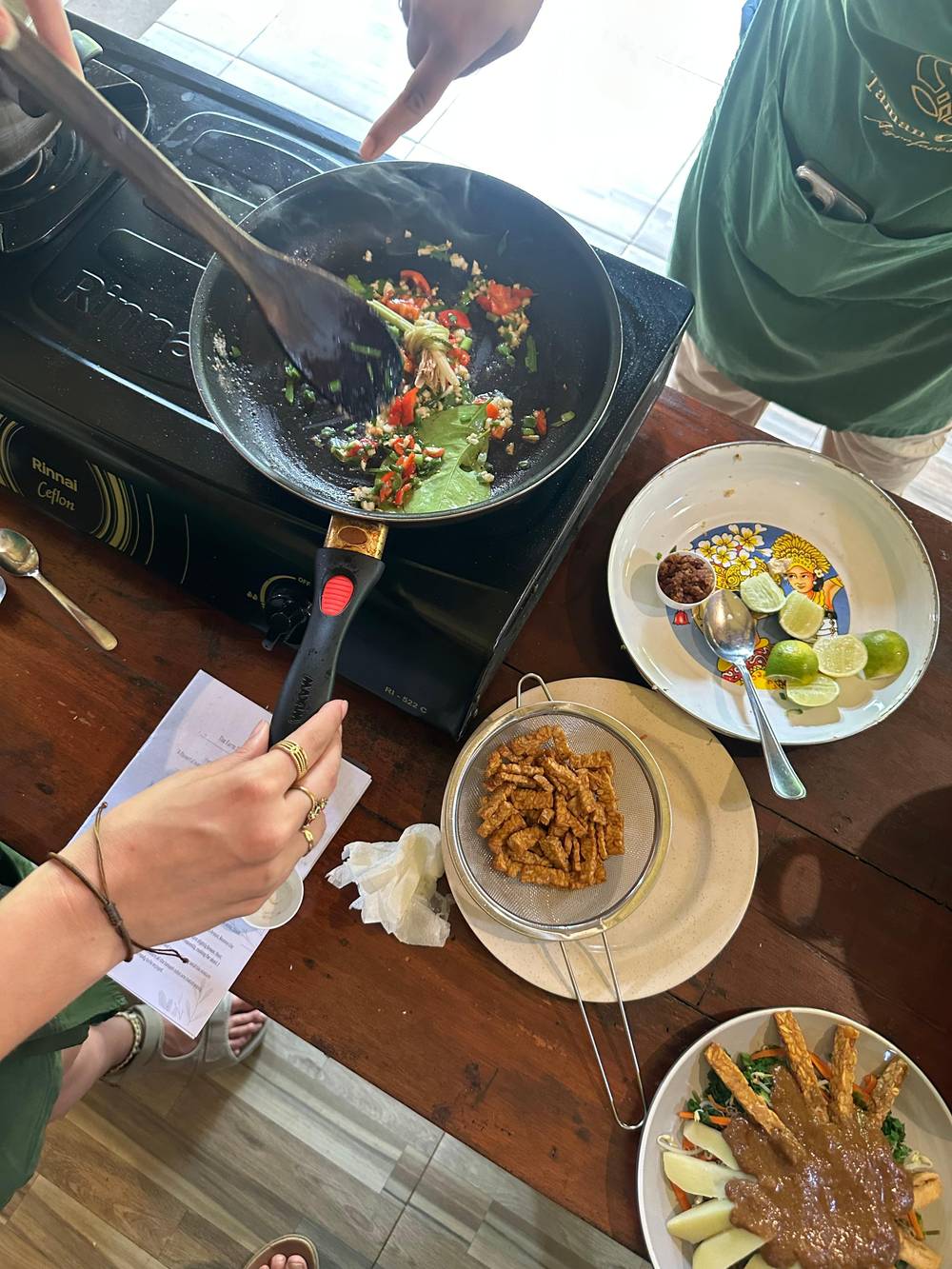
Travel & Food for Fun on YouTube · The video waits until you press play.
Begin your cooking class at a local market as you learn about the herbs, spices, fruits, and vegetables
Among the stalls
Ubud is compact and the land is hilly, so the ministry points visitors to walking or to hired bicycles and motorbikes.9 Your class may collect you from a pickup point, as the all-inclusive and Ubud village classes list.
Without a pickup, you travel yourself: the transfer class lists a meeting point in a parking field, and the rice field class lists a meeting point at a named cooking school.
The farm class shows no pickup line in the listing as we hold it, so ask whether your hotel is on a route before you book. A pickup also takes away the problem of finding the market on your own on a hilly road.
If seeing the ingredients matters to you, yes: choose a morning start and a class that lists the market, such as the farm class or the village class.
If you want a short, quick lesson, the transfer class makes the visit optional and the afternoon sessions skip it, and both are fair choices. Your day, your choice.
Whichever you choose, read the booking page for the exact date. Market hours, start times and meeting points change more often than the class itself. If you can only choose one thing from this page, choose the morning slot: it is the only one that keeps the market, the farm and the full menu in the same day.
FAQ
Our farm class, the village class and the Seminyak class all list a market visit.
The transfer class lists the market visit as optional.
The village and rice field classes skip it in the afternoon.
The all-inclusive Ubud class lists a visit of 30 minutes at Pasar Pejeng.
Every shop and market shuts on the day of silence.1
Our records for the farm class state no age rule; a dessert class in Ubud takes children from 6 years old when an adult comes along.
None of the listings we hold makes buying a requirement; a little cash covers any fruit or snacks you fancy.
Sources
Keep reading
Questions about the market, the menu or the farm? A person answers here.