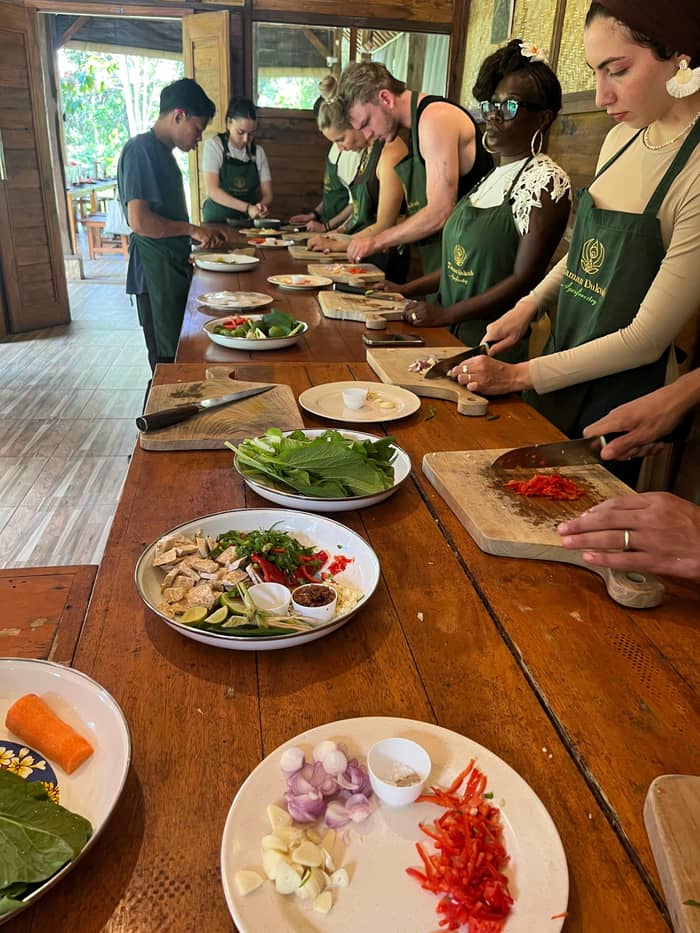
We send you here
Farm class
Regular or vegetarian
- Start price$30
- VegetarianMenu at booking
- VeganSate lilit option
- Rated4.9 from 2,005
Items to tick
Bite-sized answer
Balinese food is not uniformly spicy: sate lilit is rated mild, lawar medium and ayam betutu usually quite spicy, and tidak pedas asks for less heat.
Diet notes
Before you cook · 10 items
Mark each item as you finish it; your ticks stay on this device.
0 / 10 ready
Every box ticked. Only the booking is left: your place at the farm stove.
Hold my place at the stoveSome Balinese dishes are mild and some are fierce. This guide rates the dishes, shows how to ask for less heat, lists the classes that offer vegetarian and vegan menus and says plainly what we cannot confirm about halal.
Editorial team, balinesecookingclass.com · Updated November 3, 2026 · Roughly 6 min of reading
Start with these lines
Balinese food is not uniformly hot. Indonesia Travel rates sate lilit at a mild spice level, tum ayam at mild to medium and lawar at a medium spicy punch.1,6,2 Ayam betutu is usually quite spicy,3 and nasi tepeng is generally spicy.7 Spice also depends on the cook and the day, so treat any rating as a tendency; taste before you add more sambal, and remember that a dish described as mild in a book can still sting a first-timer.
The sambal that comes with babi guling can be very spicy,8 so the heat often lives in the side dish and not in the meat. The desserts carry none: bubur injin is sweet and creamy, not spicy at all, and jaje laklak is sweet and chewy and not spicy.9,10
That makes a plate of nasi campur a mix of mild and hot, with the sambal matah as the iconic hot spot.11 Taste a corner before you commit. A sensible way to read the ladder is to think of the main dish and the sambal separately. You can eat a mild skewer next to a fierce dip and decide on each bite how much of the dip it gets, which is how most people manage heat at a Balinese table without asking for anything special.
Diets in one grid
| Class | Vegetarian | Vegan or allergies | Start price |
|---|---|---|---|
| Farm class | Menu chosen at booking | Vegan sate lilit | $30 |
| Village class | Meat or vegetarian choice | Ask the operator directly | $35 |
| Sidemen mountain | If you ask | Vegan on request | $28 |
| Seminyak vegetarian | Wholly vegetarian | Ask the operator directly | $47 |
| Nusa Dua beach | Regular or vegetarian | Ask the operator directly | $58 |
| Market-to-table, Ubud | If you ask | Non-spicy arranged | $29 |
Diet lines as each listing states them; start prices are from-prices.
The phrase to learn is tidak pedas, meaning not spicy. Indonesia Travel says to ask for it when ordering tipat cantok, the rice cake and vegetables in peanut sauce, if you cannot handle heat.12,4
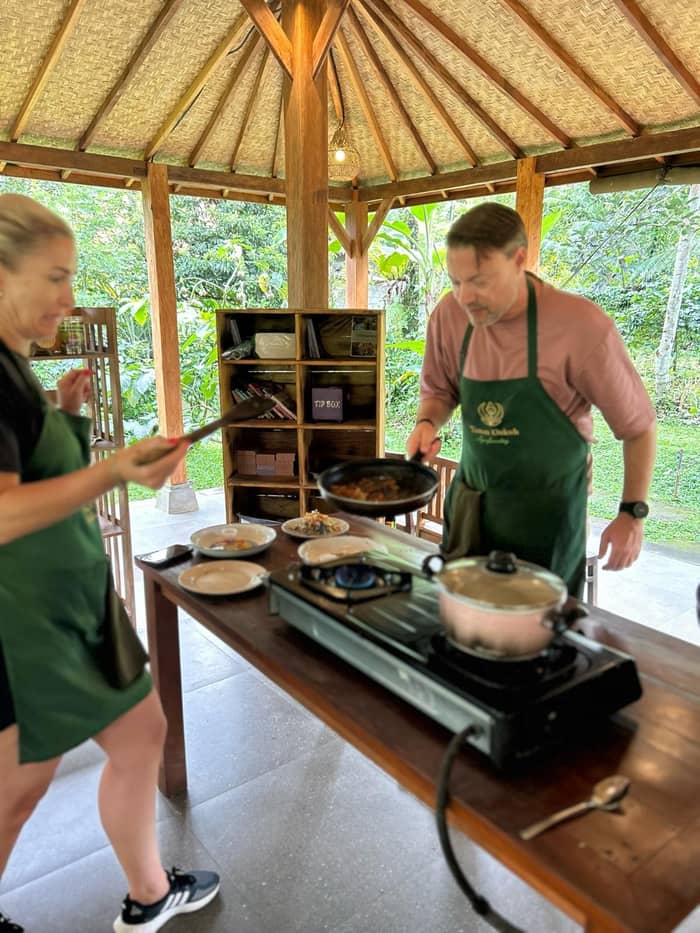
In a class the control is at the stove. One Ubud market-to-table class says vegetarian and other dietary needs are available on request and non-spicy options can be arranged.
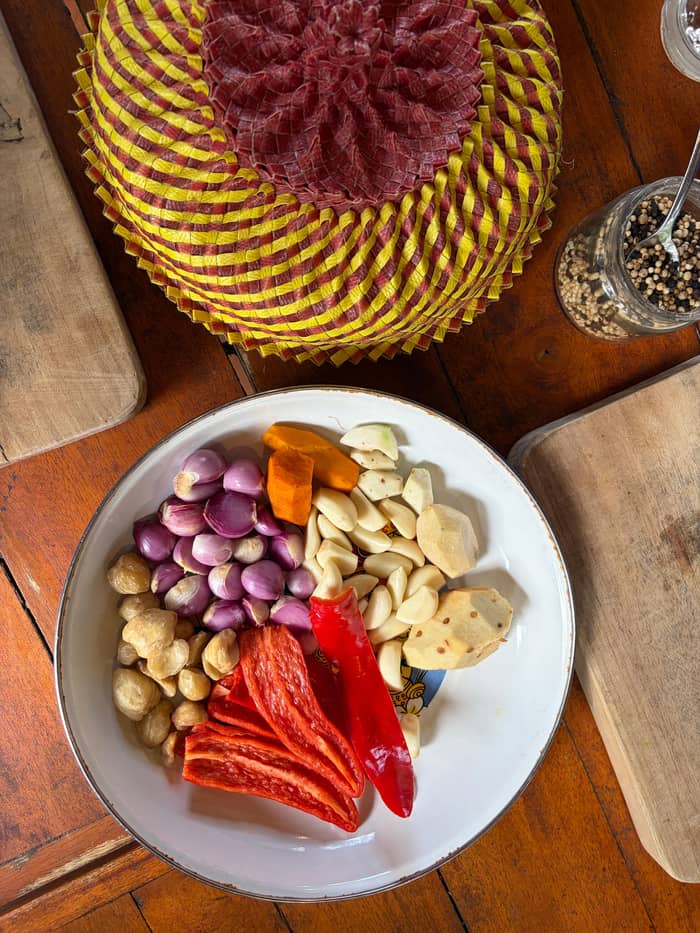
Say it at booking and again to the chef on the morning. A cook who knows you want a mild sauce will grind fewer chilies into the paste, and the dishes that are built on base genep stay recognisable without the burn. Chilies are only one source of heat. Ginger, galangal and pepper add warmth of their own, so a dish without chilies can still taste lively, and a cook can show you which one does the work in each pot.
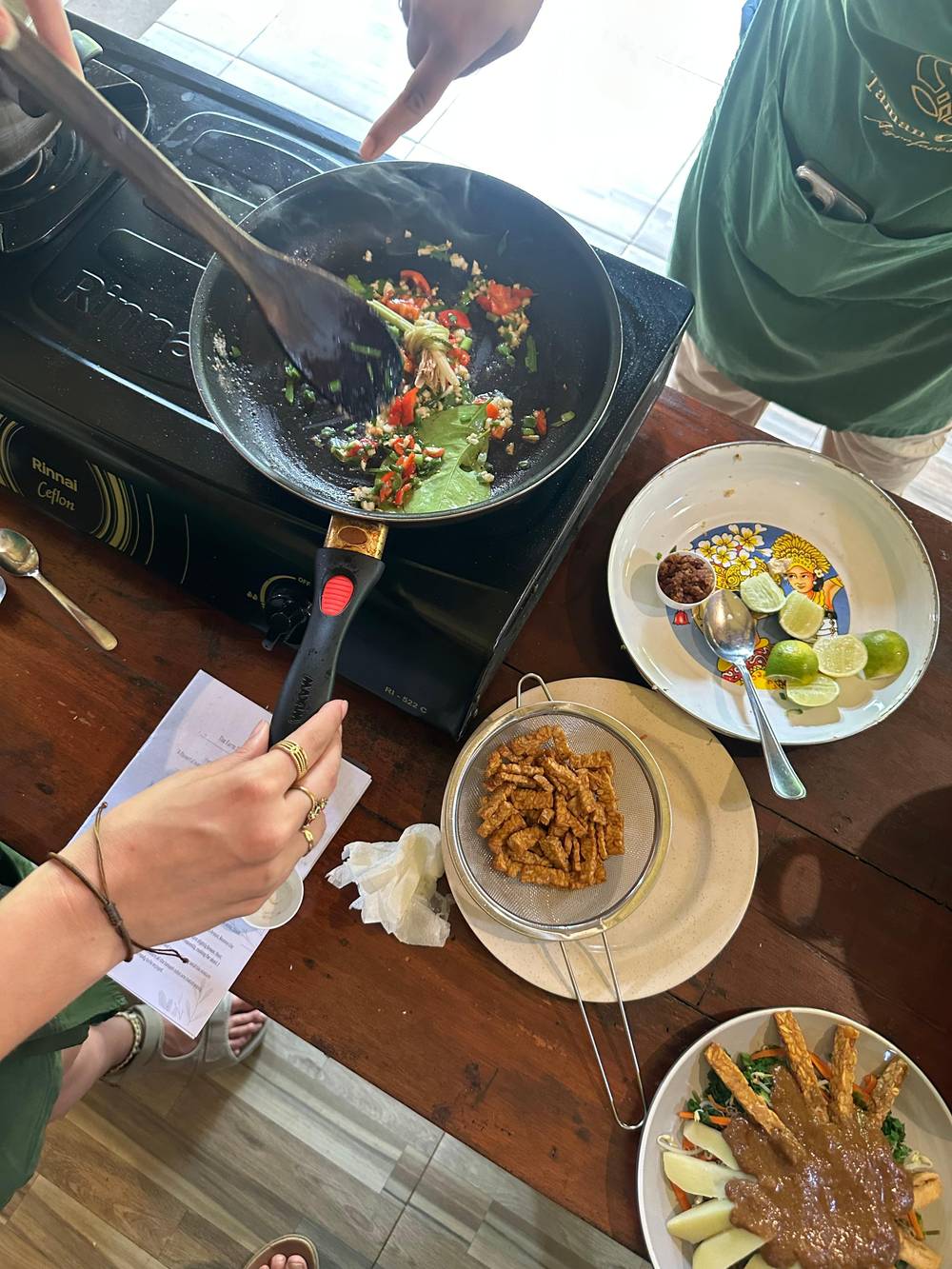
Our farm class lets you choose a vegetarian menu before the class: the spice paste base gede, gado gado, the vegetables-with-peanut-sauce plate, a tempe curry, fried corn cakes, sweet and sour tempe and a vegan sate lilit made from jackfruit.
Other classes handle it in their own way. The village class offers a choice of meat or vegetarian dishes, the Sidemen mountain class offers vegetarian or vegan on request, the Seminyak class is wholly vegetarian, and at the Nusa Dua class a regular or vegetarian menu is picked at booking.
One well-known school lists a vegetarian and a non-vegetarian menu on its own site.15 If you keep to a strict diet, a message to the operator before you book is faster than an email afterwards. Tempe and vegetables are plentiful in the island's cooking, so a vegetarian morning is never a reduced version of the regular one; the farm class cooks 6 dishes whichever menu you choose.
Match the plate to your diet
Pick the line closest to your diet and read the answer.
If I avoid meat
The farm morning
A vegetarian menu is chosen at booking.
If I follow a vegan diet
The Sidemen mountain class
Vegetarian or vegan on request.
If I dislike heat
The market-to-table class
Non-spicy options can be arranged.
If I avoid pork
Ask any operator first
Babi guling is a pig.13
If I need halal
Ask the operator in writing
No listing here states it.14
If I have a peanut allergy
Write before you book
Tipat cantok uses peanut sauce.12
Three diet-friendly classes
We send you here
Regular or vegetarian
Vegan
Sidemen woods
Mild
Ubud
Tempe, a fermented soy cake, carries many Balinese vegetarian dishes, and the farm class names it twice on its vegetarian menu. If you avoid soy, tempe is not a safe substitute, and the same goes for the peanut sauce on the plate; ask for a different dish and the cook will tell you what is left.
A private family-home class warns that certain dishes can include animal products, soy, peanuts or spices, and asks you to let the team know ahead of time about any dietary restrictions or allergies.
Peanuts are the obvious one: tipat cantok is dressed in peanut sauce.12 If you have a serious allergy, write to the operator and keep the reply. A cooking class is not a medical service, and tourists in Indonesia pay for all medical care themselves.16
Price a diet-friendly class
Pick how many will cook; each class shows its from-price for the whole group.
Line up 4 classes
Pick how many will cook; each class shows its from-price for the whole group.
≈
View≈
View≈
View≈
ViewLowest GetYourGuide prices, converted at the ECB rate; the final total appears at checkout.
Before the class, in order
When reserving
Regular or vegetarian, picked before the class.
A message
Pork, allergens, oil and heat, in writing.
On class morning
Say tidak pedas if you want less heat.4
At the stove
When the plates arrive
The dishes you cooked are the meal.
Indonesia Travel links Balinese social and cultural life closely to Hinduism.5 Its best-known dish, babi guling, is a spit-roasted whole pig stuffed with traditional spices,13 so a visitor who avoids pork should ask which dishes use it.
We cannot say that any class in this guide is halal. None of the listings we hold states halal status, so we do not claim it. This is a policy of the guide and not a judgement on any operator: a class may well cook halal food, and the only way to know is to ask it. Do not rely on a guess.
What we can report is the official picture: Indonesia's halal product assurance agency, BPJPH, says the duty to hold a halal certificate, which began for medium and large businesses in October 2024, has reached micro and small businesses and imported products since 18 October 2026, with food and beverages among the categories covered.14,17,18 That rule concerns products placed on the market, and it does not tell you what a family kitchen uses; a cook must tell you. In practice, a visitor who needs halal food should look for an operator that states it in its own description, and should ask in writing which ingredients and utensils are used, since a listing summary will not.
Video
Tasty Thrifty Timely on YouTube · The video waits until you press play.
spice level is customizable (ask for "tidak pedas" if you can’t handle heat!)
Write the questions down. Is pork used, and in which dishes? Is the menu vegetarian or vegan only? Is the oil, stock or paste free of animal products? Can the heat be reduced? Which allergens are present? Write the same list to every operator you consider, and compare the answers rather than the prices. A clear, quick reply is itself a good sign about the morning to come.
The farm class and the village class both give you a choice, which makes either the easiest to bend to your diet.
Keep the answer in writing. Plans can change on the day, and a message from the operator that you can show the chef settles most questions before the pan is hot.
Our farm class is refundable in full when cancelled at least 24 hours out, and you can reserve first and pay afterwards. If the answer from the operator is not what you need, you can cancel without a fee until 24 hours before.
Bali's levy for foreign visitors, Rp 150,000 a person and due one time, is separate and cashless, paid through Love Bali before arrival or at the desks at Bali's airport and ports.19,20
Start prices: the farm class from $30, the village class from $35, the Seminyak vegetarian class from $47. The prices above are the lowest figures GetYourGuide shows today, and the booking page for your date and group shows the total before you pay.
FAQ
Indonesia Travel tells visitors to ask for it when a dish should not be hot.4
Our farm class has a vegetarian menu chosen at booking.
The Sidemen mountain class offers vegetarian or vegan on request, and the farm class has a vegan sate lilit.
None of the listings states halal status, so ask the operator.14
The famous roast is a whole pig; ask which dishes in a class use pork.13
The farm class refunds in full.
Sources
Keep reading
Questions about the market, the menu or the farm? A person answers here.